
Was it dark or light when the children of Yisra'el (Israel) departed from Ra'meses (Rameses)?
Answer From The Annual Reading Schedule - Week 40 Notes For Numbers: This is really a question that's going to end up being a long sharing point about the Biblical Calendar as a whole, but here it goes:
I believe it was light for the following reasons:
- It says they went out before the eyes of all the Mitsrites (Egyptians) implying they saw them when they finally left (Numbers 33:3).
-
The phrase "on the morrow" is from the Hebrew מִמָּחֳרַת (MimMachorat). This Hebrew word or phrase is also used in Genesis 19:34. If we examine the events of Genesis 19, we see there are two nights involved from verse 33-35 with only one day-light portion of a day between them. It is as follows:
- Genesis 19:33 – Night – First-Born Daughter
- Genesis 19:34 – Next Day Light Part of Day (מִמָּחֳרַת – MimMachorat) – First-Born Speaks To Younger Daughter
- Genesis 19:35 – The Following Night – Younger Daughter
- Passover Night Where 1st Born of Egypt Die – They Are All Inside
- Next Day Light Part of Day (מִמָּחֳרַת), the 15th (Numbers 33:3) – They Depart
- The Following Night – They Have Already Departed
- If you believe the 1st Born of Egypt were killed on the night of the 14th, then you have to also accept morning as being the start of a numeric day.
- If you believe a numeric day starts in the evening, then you have to accept that the 1st Born of Egypt were killed on the night of the 15th.
- How long was Mosheh hid for in Exodus 2:2?
- How many days does the woman in Deuteronomy 21:13 mourn her father and mother?
- Torah Reading Notes & Related Verses For Week 40 of The Annual Reading Schedule
- The WYLH Passover Summary
- Week 70 of Sabbath Assembly Reading Schedule Covering Exodus 12:21-12:51
- Week 165 of Sabbath Assembly Reading Schedule Covering Numbers 19:1-19:22
- Week 183 of Sabbath Assembly Reading Schedule Covering Numbers 32:34-33:21
- Week 249 of Sabbath Assembly Reading Schedule Covering Genesis 19:30-20:18
- Week 298 of Sabbath Assembly Reading Schedule Covering Exodus 12:21-12:51
- Week 358 of Sabbath Assembly Reading Schedule Covering Ezekiel 46:1-46:24
- Week 393 of Sabbath Assembly Reading Schedule Covering Numbers 19:1-19:22
- Week 411 of Sabbath Assembly Reading Schedule Covering Numbers 32:34-33:21
The phrase in Genesis 19:34 is the exact same in the Hebrew as Numbers 33:3, showing that it was the very next day-light portion of a day when they left following the Passover night. It is as follows:
Let's put these two events side-by-side to make it even more clear:
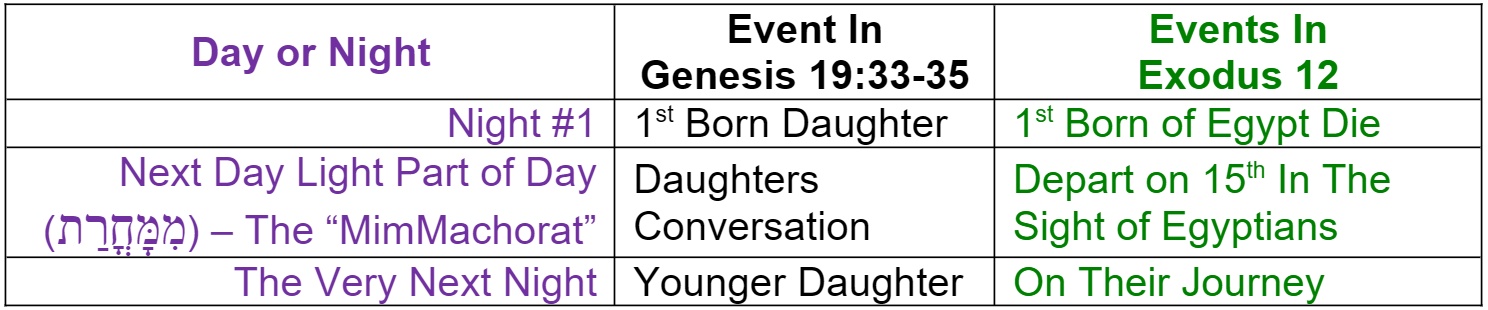
As a related note to this answer: There are some studies out there trying to prove whether the killing of the 1st born of Egypt were on the night starting the 14th or the night of the 15th, but you can see that it really doesn't make a difference what numeric day you assign to the Passover night when it comes to determining when they left. With the correct understanding of what MimMachorat means, you are left with these alternatives:
Here's another table, following up on the previous one, to display what I mean when it comes to the numeric day:
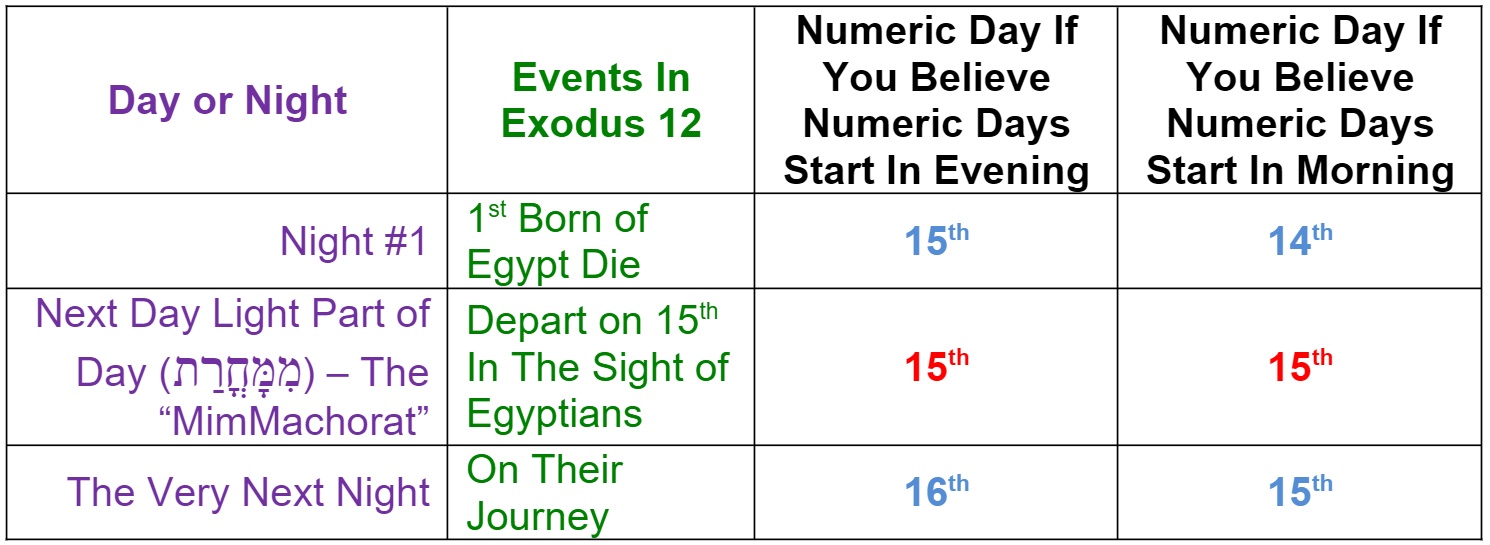
The columns in purple text and green text match identically to the previous table with purple text and green text, which are established firmly based upon the meaning of the Hebrew word MimMachorat as shown in the previous table comparing Exodus 12 to the events in Genesis 19:33-35. In other words, you can't change what's in purple and green in the above table.
You also cannot change what is in red – the 15th. That is firmly established by Numbers 33:3 and other verses which clearly state they departed on the 15th.
For people who believe the 1st Born of Egypt were killed on the 14th, you can see from the very most-right column that if you firmly hold this belief you cannot also firmly hold to the belief that the day starts in the evening – you would be forced to accept that the numeric day of the month starts in the morning.
On the other hand, if you firmly believe the numeric days start in the evening, you are forced to abandon the idea that the 1st Born of Egypt were killed on the 14th because you can see that belief forces it to be on the 15th.
Either way, you can see from the above tables that you cannot hold to the belief that the 1st born were killed on the 14th and also hold to the belief that the numeric day starts in the evening. The use of the Hebrew word MimMachorat in Genesis 19:34 shows clearly that the MimMachorat falls on the very next daylight portion of a day, not later.
This topic, of the "14th or 15th", seems to be a big debate, but to me this clears it up. I firmly believe that the Sabbath day ends in the evening with the strongest evidence being Ezekiel 46 which shows the gate is shut the six days of work and shut in the evening, showing to me that the 7th Day of Rest ends in the evening. If the 7th Day of Rest ends in the evening, then so do all the other days. That is the only logical conclusion I can come to from Ezekiel 46.
With that firm belief, I also have to accept that the 1st Born of Egypt were killed on the 15th OR, another unorthodox belief, that the numeric days do not match with the days of observance.
"Huh?" You might be saying.
Well, you can see that the Day of Atonement is on the 10th day (Leviticus 23:27), yet we begin the observance of it on the 9th Day of the Month in the Evening (Leviticus 23:32) – and that the 1st Day of the Feast of Unleavened Bread is on the 15th (Leviticus 23:6), yet we actually begin the observance of it on the 14th Day of the Month in the Evening (Exodus 12:18). This makes me wonder if it is actually required for numeric days to line up with observances, since it seems when speaking numerically that the observances cross from the 9th into the 10th and from the 14th into the 15th for these two examples.
What tends to make me think it was the 15th when the 1st Born were killed is that the New Moon sighting is the start of the month. Since the New Moon is seen in the evening, that must be when the 1st of the Month starts. If that's when the 1st of the Month starts, then the following evening must be when the 2nd of the Month starts, and so on and so forth. (This also happens to line up with how the gates shut in the evening in Ezekiel 46 which makes more sense.)
This forces me into the "evening starts a day" belief which then forces me to accept the 15th as the time the 1st Born were killed in Egypt. When does a day begin exactly though? Well, I'm not quite sure. Perhaps they started eating the Passover meal at sunset and sometime between sunset and dark, maybe at twilight when the new moon is normally seen, the days changed over numerically, taking them into the 15th. This would have them performing all the Passover laws on the 14th and finishing up by eating at the end of the 14th and into the beginning of the 15th. To me that seems to make sense.
Since I'm not sure when the day starts for certain, I start Sabbath at sunset and end when it is completely dark out just to be sure the "day" is really over. However, I tend to lean towards the belief that the day starts at the same time the new moon is seen and/or shortly after on other days during that twilight time of "in-between" where normally you also can see a few stars out as well.
Some people believe a "day" only means "day light" and some people only do Sabbath from sunrise to sunset, saying that the "day" starts in the morning.
Question: Does the "day" start in the morning?
Answer: Sure it does. But when does the night start? Obviously in the evening. Nobody disagrees on that. Ezekiel 46 is firm confirmation the day is over in the evening. You can show verses that point to "the day starting in the morning", but we can also show verses showing that "the night starts in the evening" which indicates it is no longer "day" but "night". So making the case that Sabbath or other observances start in the morning are not really substantiated to me by showing "morning starts the day" verses. I can equally show verses where the night starts in the evening, evidencing that the previous "day" is over and complete which forces that night time period to be associated with the following day rather than the one that has already occurred. Not only that, but you have Ezekiel 46 very clearly showing when the 7th Day of Rest is complete, and it didn't say morning. Ezekiel 46 is really the point where I don't see any way around accepting the simple truth that days end in the evening. This really is the only thing that makes sense considering the sighting of the new moon is also in the evening. I see no other way around it.
The day starts in the morning, the night starts in the evening, but the night also has to be assigned to a 24 hour period when it comes to observances as well. Otherwise you could have someone who works 3rd shift never needing to take off for Sabbath, and that doesn't make any sense to me. If you go by a 12-hour daylight-only Sabbath, then that would teach someone working 3rd shift they never have to ask off work, really, as long as they are done by sunrise. That's nuts to me. It doesn't make any sense. Everyone needs a break!
Also: Is the person who is unclean for 7 days according to Numbers 19 only unclean when it is daylight outside? Then when it's dark he's clean again, but then in the morning he's unclean since it is light outside? Think about that a while. That really makes no sense does it. Nope.
Numbers 19:16 (for example) says they are unclean 7 days. So when will they be clean? In the evening? Or in the morning? Obviously 7 days is referring to 7 full periods of time that involves both daylight and night time as well, not just 7 periods of daylight. Whenever it is the person becomes clean, that signifies that is the time the 7 days of their uncleanness has been completed. When is this?
Clearly in Numbers 19:19 the 7 days of uncleanness ends in the evening. I see no way to wiggle around these verses and this lines up perfectly with the new moon being sighted in the evening also, which would start day 1 of the month.
Yes – The first "day" of the month does start in the morning – but the first night of the month starts in the evening when the new moon is sighted – so in summary, the 1st starts in the evening. It's really simple.
So those are the two strongest witnesses, Ezekiel 46 and Numbers 19, in the Scriptures proving 1) "day" does not always mean "daylight only" and 2) days are completed in the evening. The third witness (#3) is the moon sighting which occurs in the evening also.
If I see the new moon, now what? Do I have to wait until morning before blowing the shofar? What day of the month is that time period between when the new moon is seen and the morning daylight? Has to be the 1st. No way around it really if you go by the first crescent moon for the months.
Some people go by calendars that don't use the moon for determining the months. To those who consider such, I ask these two questions:
Those who go researching these verses in the Hebrew will see I have made my point. Obviously the moon is used for time keeping in regards to the months.
I know some go by conjunction or full moon or other methods other than the first crescent sighting, but none of those methods seem to be something we could do easily without using modern technology. Also, I have not seen any compelling historical witnesses to attest to any other method being accurate.
If you're wondering about thoughts on lunar Sabbath doctrines, see the reading notes for Week 34 which covers Numbers chapter 10 (a key chapter for discussing that topic).
If I'm wrong about any of these calendar issues, please feel free to correct and point out what I'm missing after you have read all the points I've made here. I've studied lots of different calendars and I'm open to correction if I'm wrong. I'm not claiming perfection, and I don't want to "debate", but the calendar issue does come up with studying the Scriptures and we do have to determine for ourselves the best we understand when to keep Yahweh's set-apart days. Study out all this for yourself, because I admit I could be wrong on some of this. However, I did my best based upon my best understanding at the time of writing this.
Please also refer to the Biblical Calendar Study I put together which covers many issues of the calendar as well, sometimes in more detail than here.